

If you are building a crypto project or business, you need to figure out how it will connect to external platforms for data and ease of execution. Crypto APIs offer a solution for that. However, not every crypto project you are building needs a budget plan for an API. If you are building a side project, testing an idea, or running a small bot, a free crypto API tier is often all you need.
This guide ranks the best free crypto APIs based on their functionality, asset coverage, and the free plan they offer.
After our evaluation, ChangeNOW emerges as the best free crypto API. Its integration is made easy through a partner account. Once integrated, you get access to 1,500+ coins and 2.25M+ trading pairs across 110+ networks with fiat on/off-ramp support. The API also offers fast response times with 99.99% uptime, a 350ms response time, and a 10-minute incident warning window, backed by 24/7 support. Also, unlike most competitors, its free tier has no rate limits or monthly fees.
Selection Criteria
A free crypto API is useful if it can actually do the job you need. To see which one can, we evaluate the providers in this list across three areas:
Functionality: Here we evaluate what the free crypto API lets you do, whether it is to access market data or execute trades. We also look at the connection solutions each provider offers, such as REST, WebSocket, or FIX, and any other extra features it might offer, such as an MCP (Model Context Protocol) server for AI agents and LLM integration.
Assets Coverage: Here we look at the number of tokens an API returns data for or lets you trade and across how many blockchains or networks.
Free Plan: If it is a free product, then we need to see what can be accessed using that free offer. Here, we evaluate the terms each provider’s free plan carries, such as the rate limits or credits.
Each of these cryptocurrency APIs differs across the above areas. The table below provides a direct comparison for easier evaluation:
ChangeNOW
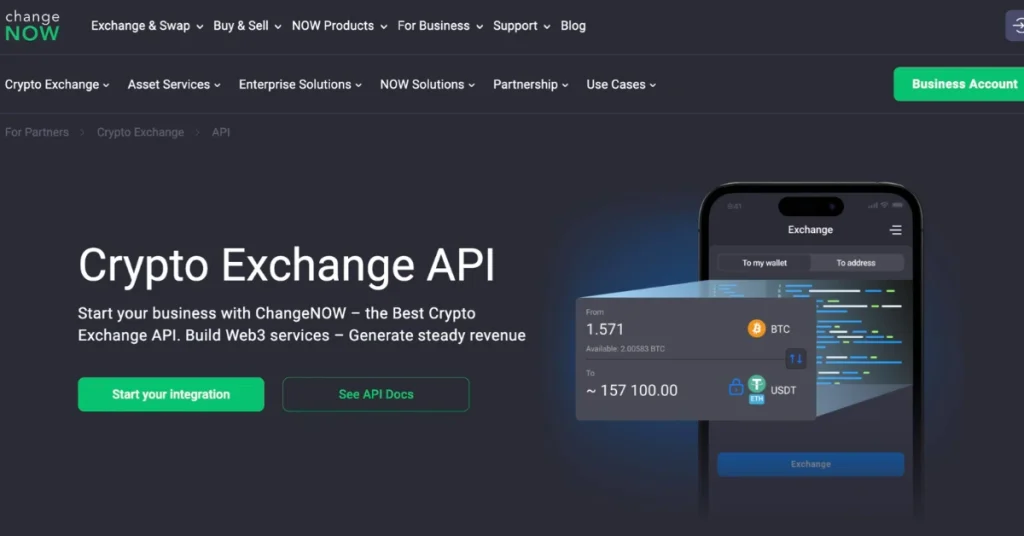
Overview: ChangeNOW Crypto API is a non-custodial exchange API that lets platforms integrate instant crypto swaps. It is built as a plug-and-play layer where, when you integrate the API, users swap directly on your platform while it handles liquidity routing and settlement. This makes it ideal for wallets, payment gateways, and DEX aggregators that want swap functionality without building an exchange from scratch.
Functionality: ChangeNOW’s API is a REST-only swap and liquidity engine that lets your business create and track transactions. Its authentication runs on a single API key issued when you join the Partner Program. The solution comes with a 99.99% reliability, 350 ms response time, and a 10-minute incident warning time, plus 24/7 support and free post-integration maintenance.
As a partner you also enjoy a fiat on/off-ramp with support for 50+ fiat currencies and a commission starting at 0.4% per transaction, which you can customize by asset, pair, or swap size.
Assets Coverage: ChangeNOW supports 1,500+ coins and 2.25M+ trading pairs across 110+ networks, with liquidity sourced from both CEXs and DEXs.
Free Plan: Unlike most providers on this list, which have credit-based limits, ChangeNOW’s API is completely free with no limits, allowing partners to launch and test integrations without upfront investment.
CoinStats
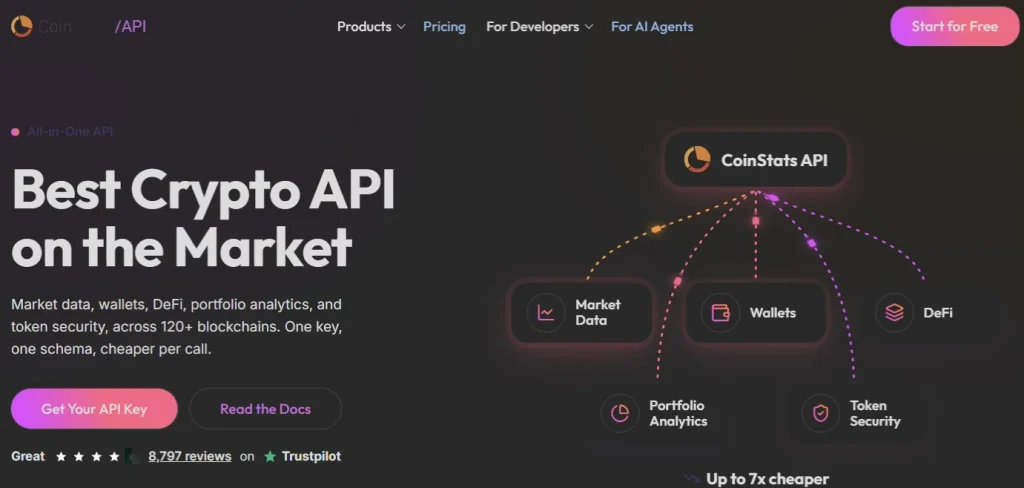
Overview: CoinStats API is a unified crypto data platform where businesses can access a wide range of services. It provides market data, wallet balances, exchange data, DeFi protocol data, and crypto news. This unified coverage is different from most crypto data aggregators, which mostly focus either on raw market data (like price feeds) or on siloed on-chain information.
Functionality: CoinStats is primarily a REST-only data API. It offers JSON responses and API-key authentication with no WebSocket feed. The API also supports an MCP server through which AI assistants can query it directly without custom integration code.
Assets Coverage: The API covers 120+ blockchains, 10,000+ DeFi protocols, and 200+ exchanges (both CEX and DEX) supporting 100,000+ coins.
Free Plan: CoinStats provides a credit-based free tier with 20,000 credits/month capped at 2 requests per second.
Kraken
Overview: As a crypto exchange, Kraken offers a free cryptocurrency trading API that gives developers and businesses direct access to spot trading, futures, and real-time market data. It is designed for algorithmic traders, institutions, and developers building trading applications.
Functionality: Kraken splits its API into spot and derivatives products, each reachable over REST, WebSocket, and FIX. Authentication differs by endpoint type, where public market-data calls need no key, while private account calls use an API key + HMAC signing, and trading calls run on a separate points-based limiter tied to order-book activity.
The API also ships first-party AI tooling, where its CLI includes a built-in MCP server that allows safe agent testing.
Assets Coverage: Kraken supports more than 640 crypto assets and hundreds of trading pairs spread across spot and derivatives markets.
Free Plan: The API is free but with a rate limit, which runs on three separate tiers where public REST calls should stay near 1 request per second, private (account) calls at 20, and refills at 0.5–1 point per second depending on verification tier, and trading calls, which use their own points system based on order-book interaction.
Binance
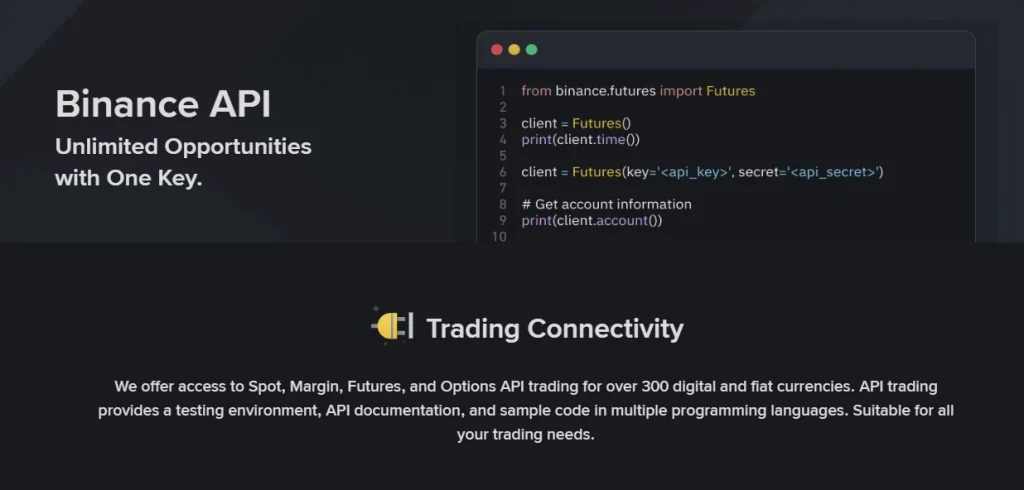
Overview: Binance API gives direct access to its live spot, margin, and futures markets. Through this connection, businesses can display the exchange’s real-time market data in their own dashboard. The API is useful for trading bots, execution tools, liquidity dashboards, and exchange-specific analytics.
Functionality: Binance supports both REST and WebSocket streams. REST is used for order placement and WebSockets for real-time market data updates. Public market-data endpoints need no authentication, while private endpoints (trading, account balances) use an API key + HMAC-signed requests.
Assets Coverage: The API covers over 350 cryptocurrencies listed on the exchange and 1,000+ trading pairs.
Free Plan: Binance’s public API is free for both market data and trading on the exchange itself. However, this comes with rate limits that apply per endpoint weight, with the spot API capped at 6,000 requests per minute while the futures API allows 2,400 requests per minute. Higher limits scale with the VIP tier earned through trading volume.
Coinbase
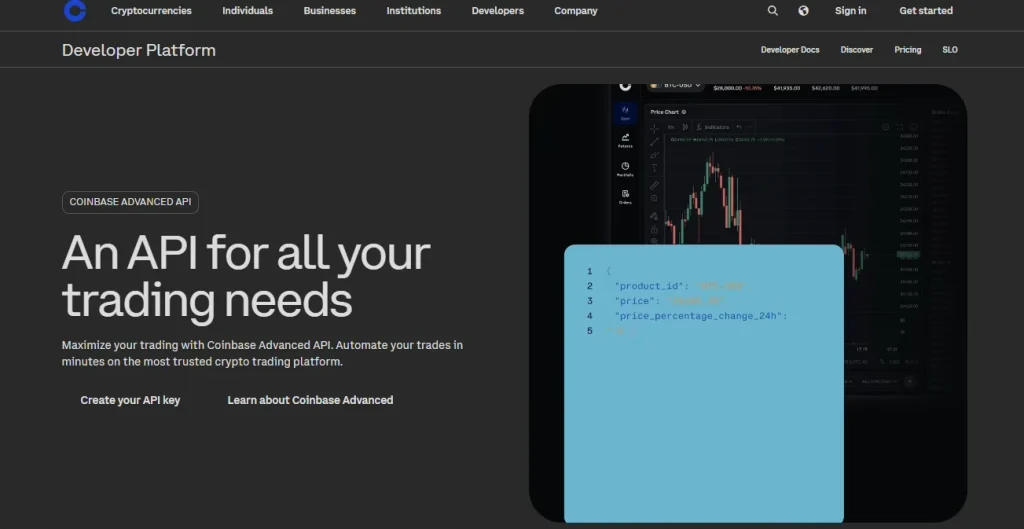
Overview: Coinbase offers an Advanced Trade API that supports programmatic trading, order management, and real-time market data for developers. However, the API is exchange-specific rather than a broad market-data aggregator. This means it only returns data for what is listed on Coinbase.
Functionality: Coinbase API is split into two categories: trading and market data. Trading API require authentication and let you place orders and access account information, while the market data API provides market data and is public. Connectivity options include REST, FIX, and WebSocket.
Assets Coverage: The free crypto API allows access to hundreds of cryptocurrencies listed on the exchange together with their associated 550+ market trading pairs.
Free Plan: There is no subscription fee for API access; instead, costs come from trading fees on executed orders. Rate limits differ by endpoint type, where public market-data endpoints are limited to 10 requests per second, private endpoints to 30 requests per second, and the FIX API to 50 messages per second.
Conclusion
A free crypto API can save your project or business months of engineering work and infrastructure costs. Instead of building from scratch, you just have to integrate proven providers through a single connection. While this sounds straightforward, remember you also have to carry out some thorough evaluation around areas like functionality, asset coverage, and what the free plan actually means. This is what will help you easily match your project to the correct solution. But remember, whichever crypto project you are working on, the providers in this guide offer you reliable free options you can start with.