
NVDA Stock Price Today
NVDA Stock Metrics
NVIDIA has evolved from a graphics-chip company into a full-stack accelerated computing and AI infrastructure leader. Its expanding Data Center business, Blackwell and Rubin platforms, networking technologies, and software ecosystem have positioned the company at the center of the global AI buildout. Record Data Center revenue and strong overall growth continue to underpin Nvidia’s long-term investment case.
CoinPedia’s Nvidia Stock Price Prediction for 2026
Fundamental Analysis
Nvidia’s fundamental strength is increasingly concentrated in its Data Center business, which has become the primary driver of revenue and earnings. The company generated $215.9 billion in FY2026 revenue, while Q1 FY2027 revenue reached a record $81.6 billion. Data Center revenue accounted for $75.2 billion, rising 92% year over year, reflecting continued demand for accelerated computing, AI infrastructure and networking.
The valuation debate now centers on the durability of that growth at Nvidia’s scale. Management’s Q2 FY2027 revenue outlook of approximately $91 billion points to continued demand, but investors will increasingly focus on Blackwell and Rubin adoption, hyperscaler capital expenditure, gross margins and competition from custom AI accelerators.

For NVDA to reach a $6 trillion valuation, sustained earnings growth will be the critical variable. The company must continue expanding revenue and profitability fast enough to support a higher market capitalization without relying solely on multiple expansion.
Technical Analysis:
NVDA has regained its bullish structure after breaking out of the bullish flag that developed following its May peak. The pattern formed as price consolidated through June and July, with the $190-$200 area repeatedly attracting buyers. The subsequent breakout above the descending flag resistance triggered a fresh upmove, taking NVDA back above its 20-, 50- and 200-day moving averages and establishing a sequence of higher lows and higher highs.
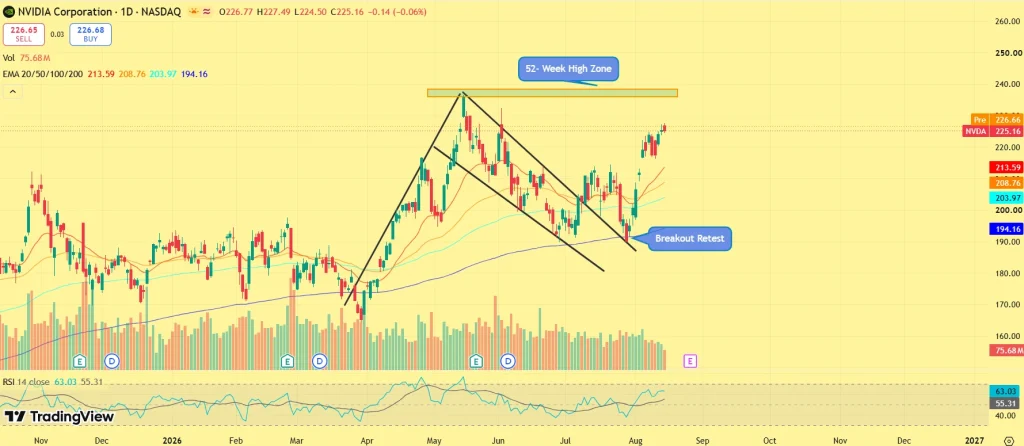
The latest move has brought NVDA to around $225, putting the stock directly below its $236.54 record high. A sustained breakout above $236.54 would confirm the continuation pattern and shift the chart into price discovery, with $250 as the first psychological target, followed by the $275-$300 zone. The setup remains constructive while price holds above the $213-$217 support band; a deeper move below $203-$209 would weaken the current higher-high structure.
Nvidia Corp. (NVDA) Monthly Price Prediction 2026
NVDA Price Prediction 2027-2030
Long-Term NVDA Price Prediction
Expert & Analyst Predictions
What Does Nvidia Stock Price Depend On?
Nvidia’s valuation is primarily tied to the pace of AI infrastructure spending, its ability to convert demand into revenue and earnings, and its ability to maintain technological leadership. As its Data Center business has become the dominant revenue driver, changes in hyperscaler spending, product cycles, margins and investor expectations can have a significant impact on NVDA’s stock price.
AI & Data Center Spending: Capital expenditure by hyperscalers and enterprises remains the biggest demand driver for Nvidia’s GPUs, networking and accelerated-computing platforms.
Blackwell & Rubin Adoption: The pace of deployment of Nvidia’s latest and next-generation AI platforms will influence revenue growth and the strength of future product cycles.
Earnings & Profit Margins: Revenue growth, operating leverage and gross margins directly influence earnings expectations and the valuation investors are willing to assign to NVDA.
Hyperscaler Demand: Spending from major cloud providers and large AI developers can materially affect Nvidia’s order pipeline and Data Center growth.
AI Chip Competition: Custom AI accelerators and competing products could pressure Nvidia’s market share, pricing power and margins over time.
Export Restrictions: U.S. semiconductor export controls, particularly those affecting advanced AI chips, can restrict Nvidia’s addressable market and increase regulatory uncertainty.
Supply Chain & Manufacturing: Advanced-node production capacity, packaging availability and supply-chain execution remain important factors in Nvidia’s ability to meet AI chip demand.
Valuation & Investor Expectations: At Nvidia’s current scale, the stock increasingly depends on whether earnings growth can justify its valuation. Even strong results can trigger a sell-off if they fall short of elevated expectations.
Interest Rates & Market Liquidity: Higher interest rates can compress valuation multiples for high-growth technology stocks, while stronger liquidity and risk appetite can support expansion.
Technology Leadership: Nvidia’s CUDA ecosystem, accelerated-computing architecture, networking products and rapid product launches remain critical to defending its competitive position as the AI semiconductor market evolves.
Ultimately, NVDA’s stock price depends on three variables: how fast AI spending grows, how efficiently Nvidia converts that spending into earnings, and how much investors are willing to pay for that growth.
How CoinPedia Generated NVDA Stock Price Predictions
Business Growth & Earnings Drivers
Our analysis focuses on the factors directly influencing Nvidia’s earnings trajectory, including Data Center demand, AI accelerator adoption, Blackwell and Rubin platform sales, networking growth, gross margins, operating leverage and hyperscaler capital expenditure. Nvidia’s ability to convert sustained AI demand into revenue and free cash flow remains central to its long-term valuation.
Competitive Position & AI Leadership
Nvidia’s valuation is assessed against its position within the global AI semiconductor industry. We evaluate its CUDA software ecosystem, accelerated-computing architecture, networking portfolio, product roadmap and competitive position against custom AI chips and rival accelerator platforms. Sustaining technological leadership remains critical to supporting premium valuation multiples.
Technical Market Structure
AI Industry & Macroeconomic Environment
The forecast also incorporates broader variables including hyperscaler AI spending, semiconductor demand, interest-rate expectations, market liquidity, export restrictions, supply-chain conditions and investor sentiment toward high-growth technology stocks. These factors can influence both Nvidia’s earnings outlook and the valuation multiple investors assign to future growth.
Conclusion
Nvidia’s next major stock-price move will depend on whether its exceptional AI-driven growth can continue at increasingly larger revenue and earnings levels. The critical variables are Data Center demand, Blackwell and Rubin adoption, margins and hyperscaler spending, not simply the broader AI narrative.
With NVDA approaching its $236.54 record high, the technical setup adds another important catalyst. A sustained breakout could open the door to new price discovery, while failure to clear resistance would keep the stock vulnerable to another consolidation phase. If Nvidia continues delivering earnings growth at a pace capable of supporting higher valuations, the $6 trillion market-cap milestone becomes a measurable outcome of sustained execution rather than a purely speculative target.
Frequently Asked Questions (FAQs)
1. Is Nvidia (NVDA) stock a good investment?
Nvidia remains one of the strongest large-cap AI infrastructure plays, supported by Data Center growth, accelerated computing, networking and its CUDA ecosystem. However, the stock’s valuation reflects high growth expectations, making earnings execution, AI spending and margins critical to its future performance.
3. Can Nvidia stock reach $300?
Yes. A sustained breakout above the $236.54 record high could put NVDA into price discovery, with $250 as the first major psychological level and $275-$300 as the next upside zone.
4. What factors could drive NVDA stock higher?
Continued hyperscaler AI spending, strong Blackwell and Rubin adoption, rising AI inference demand, Data Center growth, expanding networking revenue and sustained profit margins could support further upside in NVDA.
5. Can Nvidia become the first $6 trillion company?
Nvidia could reach a $6 trillion market capitalization if earnings continue expanding at a pace that supports a substantially higher valuation. The key requirement is sustained revenue and profit growth rather than multiple expansion alone.