
Story Highlights
- The live price of the Stacks token is Loading live price .
- Price predictions for 2026 range from $0.50 to $2.50.
- Long-term outlook suggests gradual growth potential to approach $20 by 2030.
Stacks is the Bitcoin layer where Bitcoin holders come to grow their BTC through Bitcoin-native finance, and STX is what powers it: the gas asset, the Stacking asset, and soon the capacity asset for a new self-custodial yield product called Bitcoin Staking.
STX trades around $0.27 in late August 2026 after one of its strongest short-term moves of the year. The token was trading near $0.12 in mid-August before more than doubling within roughly a week, reclaiming the $0.20 level and approaching $0.30. The move also illustrates STX’s potential role as a higher-beta Bitcoin asset, amplifying changes in Bitcoin sentiment while adding exposure to growth within the Stacks ecosystem.
The opportunity behind that number is Bitcoin itself: most of Bitcoin’s roughly $1.32 trillion market cap sits idle, and every mechanism below is a different way of turning a sliver of that idle BTC into activity that runs through STX.
This STX price prediction walks through two things together: the bonding mechanism behind Bitcoin Staking, and the gas demand building underneath it as Bitcoin-native finance grows on Stacks, then lays out what would need to be true for STX to re-rate through 2026 and into 2030.

Stacks Price Today
What Creates Demand for STX?
Most tokens accrue value one way. STX has three separate jobs running at once, and each one pulls on demand differently.
It’s the fee asset. Every swap, loan, and contract call on Stacks costs STX, so usage of Bitcoin-native finance turns directly into token demand. That layer is still small but building: DeFiLlama puts total value locked across Stacks protocols at about $86 million.
USDCx, native USDC on Stacks, went live in December 2025, and Fireblocks supports Stacks for institutional custody, both aimed at making it safer for institutions and Bitcoin holders to actually deploy BTC productively rather than leave it idle. Every one of those transactions runs on STX for gas, and that demand moves as fast as Bitcoin-native finance grows on its own.
It’s the Stacking asset. Lock STX, and you’re securing Proof of Transfer (PoX), the consensus mechanism where Stacks miners bid Bitcoin for the right to produce blocks, and that Bitcoin gets paid out to the people who locked STX. Since January 2021, PoX has paid out more than 4,200 BTC this way.
And soon, it’s the bonding asset for Bitcoin Staking. This third job is the one that changes the math.
How does Bitcoin Staking’s 5% bonding requirement affect STX?
Bitcoin Staking works by letting a BTC holder lock their coins on Bitcoin’s own base layer, in their own wallet, no bridge, no wrapped token, and pair that locked BTC with an STX position worth roughly 5% of it.
That pairing is what unlocks the position and lets it start earning. Stacks is targeting an annualized yield near 3% in BTC, paid from the same PoX mechanism that has already distributed 4,200+ BTC since 2021. Positions run on a roughly six-month term; leaving early is possible, but it means giving up whatever yield hadn’t accrued yet.
Run the ratio forward, and the demand curve for STX gets concrete fast. Say 20,000 BTC ends up bonded at a $65,000 BTC price: that’s $1.3 billion in locked Bitcoin, and at 5%, roughly $65 million in STX would need to be paired against it just to open those positions. Nobody knows if 20,000 BTC shows up. But the relationship is fixed by design: more BTC bonded means more STX required, and that’s a different kind of demand than a marketing push or a limited-time incentive. It’s demand created by usage.
There’s a second consequence that matters just as much. STX paired into a bond isn’t sitting on an exchange for six months. It’s locked. If Bitcoin Staking pulls in real BTC volume, the market could see new demand for STX and a shrinking free float at roughly the same time. That’s the mechanism behind some of the more optimistic long-range price cases.
None of this converts automatically into new spot purchases. A participant can pair STX they already hold, buy it over the counter, or borrow against future positions. The mechanism creates a demand requirement. It doesn’t guarantee where that STX comes from.
How does Bitcoin-native finance growth create gas demand for STX?
Bonding math gets the attention because it’s a new, clean number. But it’s not the only lever, and it’s worth not losing sight of the one that’s already running: STX as gas. The common thread across these products is BTC-denominated yield rather than BTC being swapped into something else to chase a return.
Zest leads Bitcoin lending on Stacks with 800 BTC in deposits, Stacking DAO says it will launch a BTC LST once Bitcoin Staking goes live, and Zest has said it plans vaults on top of that LST to compound the yield further. Hermetica runs its hBTC vault, and Bitflow provides the exchange infrastructure that lets it all move. USDCx, native USDC on Stacks since December 2025, gives that liquidity a stablecoin base to trade and lend against.
Every swap, loan, and liquidation across this stack burns STX for gas, demand STX is already earning today, independent of a mainnet date. Worth noting: several of these products are pre-launch, and their scale is a claim from the teams building them, not yet a measured result.
The two drivers compound if both work. Bitcoin Staking, if it launches and draws BTC, brings new capital and new users onto Stacks. That capital needs somewhere to go once it’s there, and Zest, Stacking DAO, and whatever launches next are the places it goes, which turns into more transactions, which turns into more gas demand for STX.
Bonding creates demand in bursts: each position needs its 5% of paired STX once when it opens, and again if it renews after the six-month term. Gas demand compounds with every transaction, indefinitely, as long as usage keeps growing.
What could this mean for the STX price?
The demand mechanisms above do not translate directly into a specific STX price. Bitcoin performance, broader crypto market conditions, liquidity and investor risk appetite remain major variables. STX can therefore act as a higher-beta expression of Bitcoin, when Bitcoin sentiment improves, it can benefit both from broader market momentum and from rising expectations for Bitcoin-native activity on Stacks.
Its smaller market capitalization and more concentrated liquidity can amplify those moves, but also increase downside volatility.
The latest rally provides a useful example. STX traded near $0.12 in mid-August before more than doubling within roughly a week. In the process, the token reclaimed the $0.20 to $0.22 area and moved toward $0.30. That move alone does not confirm a longer-term reversal, but it does materially change the short-term technical setup.
STX Crypto Price Prediction 2026 – 2030
STX technical roadmap 2026 – 2030
The first area to watch is $0.20 to $0.22. Holding that critical support zone would preserve the recovery structure, while a breakdown could put $0.15 back into focus. The next immediate test sits around $0.26 to $0.30. A sustained move through $0.30 would bring the $0.35 to $0.42 supply zone into focus.
The broader $0.38 to $0.50 region is more important from a structural perspective. A clean move through that area would suggest the recovery has moved beyond a short-term rebound and into a larger repricing. Above $0.50, the next reference zone sits around $0.60 to $0.75. From there, $1 becomes the next major psychological and market-structure level. Beyond $1, the analysis becomes less about today’s technical breakout and increasingly about whether STX enters a broader cycle expansion.
That creates a rough progression of $0.20 → $0.30 → $0.40 → $0.50 → $0.75 → $1.00. Levels above that belong more appropriately in a price-scenario framework than in the immediate technical roadmap.
A single price target would imply more certainty than the market allows. For 2026, the scenarios range from $0.50 to $2.50, with $1.50 as the average case. Reaching the upper end would require constructive Bitcoin conditions, a successful Bitcoin Staking rollout and measurable growth in Stacks-based financial activity.
The forecasts widen significantly after 2026, as shown below. Longer-term outcomes depend increasingly on Bitcoin market cycles, Stacks adoption, STX issuance and the amount of BTC deployed across the ecosystem, making the later estimates considerably more speculative.
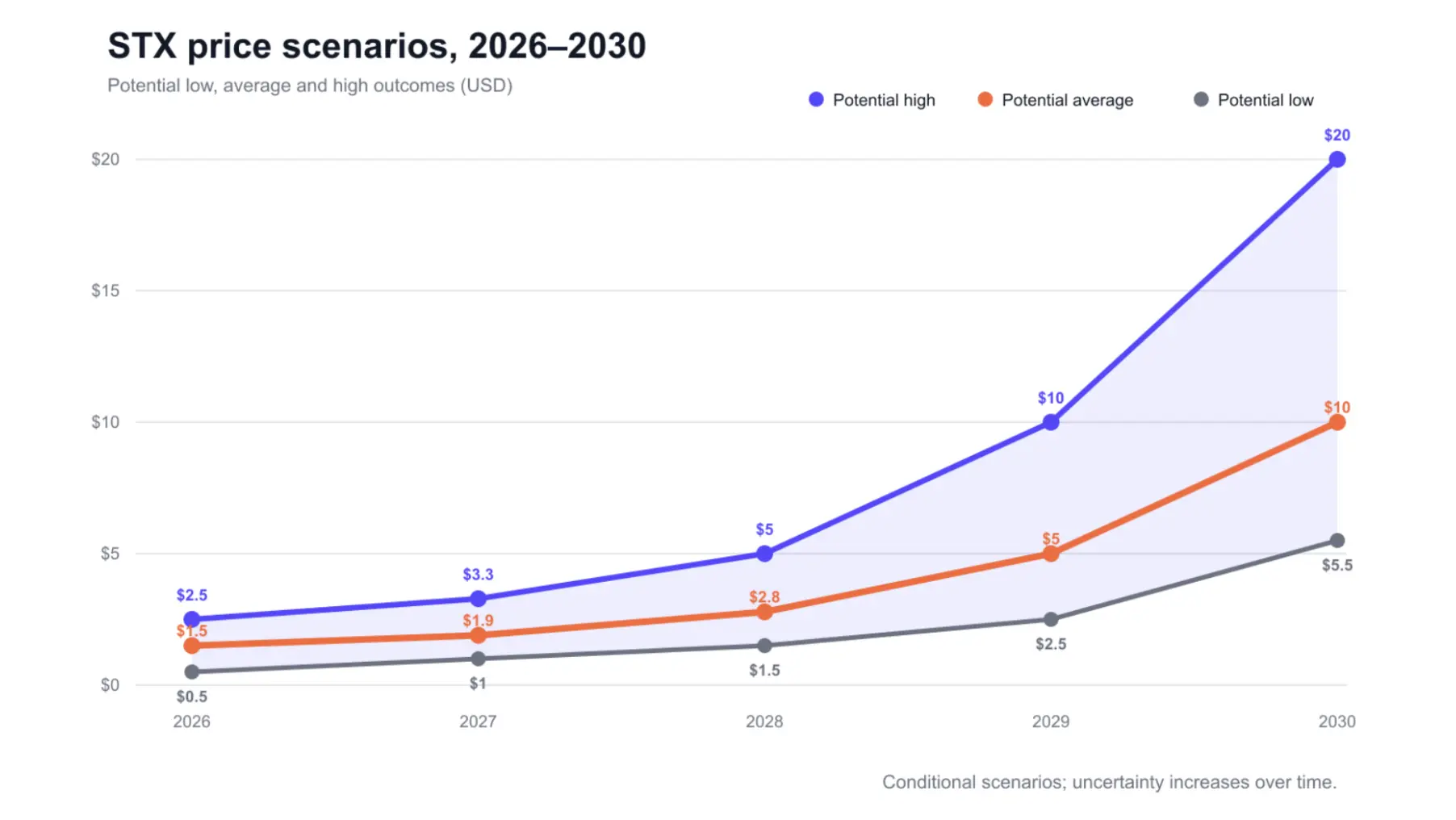
The distinction between the technical roadmap and these forecasts matters. The $0.20, $0.30, $0.40, $0.50, $0.75 and $1 levels can be connected to the market structure STX is trading through today. The $1.50, $2.50, $5 and higher figures are scenario estimates whose realization depends on additional assumptions being met over time. The further the forecast extends, the greater that uncertainty becomes.
STX Coin Price Prediction 2031, 2032, 2033, 2040, 2050
Based on the historic data and trend analysis of the cryptocurrency along with the market sentiments, here are the possible STX price targets for the longer time frames.
STX Price Prediction: Market Analysis?
What are the risks to the STX price prediction?
Everything above is a case for what could happen. Here’s what would have to go wrong for it not to.
The higher-beta relationship works in both directions. Even a strong Bitcoin Staking launch doesn’t insulate STX from a broader crypto downturn or a Bitcoin correction. The same volatility that can amplify upside can also produce larger drawdowns. Regulatory shifts around crypto yield products generally are a separate variable Stacks doesn’t control either.
Bitcoin Staking isn’t the only BTC-yield option on the table. Other Bitcoin L2s and custodial platforms are pursuing their own versions of BTC yield, some without requiring a paired altcoin position at all. STX’s bonding requirement is a differentiator, not a moat, and capital that could bond into Stacks can just as easily go to a competing product if the terms look better.
The bonding side is still unproven. Mainnet hasn’t launched, so every number in the bonding math above describes a design, not a result. Even after launch, the mechanism only creates STX demand if BTC holders actually bond in. Nothing forces that. Holders who’ve spent years avoiding yield products because of bridges, wraps, and custody risk may still take time to trust a new one, however different the design.
There’s also a structural feedback loop to account for. STX value, how much Bitcoin miners bid through PoX, how much staking capacity the protocol can support, and the BTC yield participants actually receive are all tied to each other. That helps on the way up and hurts on the way down: weaker STX economics or thinner miner bids pressure the yield the whole product depends on. Stacks has built in capacity limits, reserve buffers, and a staged rollout to manage that, but no protocol design removes the underlying market risk.
The gas side is mostly still a roadmap. Zest’s 800 BTC in current deposits is real and measurable, but Stacking DAO’s BTC LST, the Zest vaults meant to sit on top of it, and some of the other products expected around Bitcoin Staking are at earlier stages. Any of them could slip, ship smaller than planned, or lose users to a competing chain that ends up cheaper or faster. Stacks DeFi’s entire TVL, across every protocol, is about $86 million today. That’s the honest scale of the “already running” engine: real, but tiny next to Bitcoin’s $1.32 trillion market.
The two engines are also not independent of each other. A meaningful share of the bullish case for gas demand assumes Bitcoin Staking succeeds first, since that’s what’s expected to bring the new BTC that Zest’s vaults and Stacking DAO’s LST are built to capture. If bonding underperforms, the ecosystem side likely grows slower too, even though it doesn’t strictly require Bitcoin Staking to exist.
None of this means the thesis is wrong. It means both halves are still early, one is unlaunched and the other is under-scaled, and a real STX price prediction has to hold both of those facts at the same time as the upside case.
What would need to happen for STX price to rise?
Through the rest of 2026: on the bonding side, mainnet activation for Bitcoin Staking, targeted for September, and the first institutions actually deploying BTC into it. On the gas side, continued growth past the current $86 million in Stacks DeFi TVL as the lending, stablecoin, and yield products building on top of it expand. The second one doesn’t depend entirely on the first. If Bitcoin Staking slips, gas demand from a growing Bitcoin-native finance layer is still a real, if slower, catalyst on its own.
By 2027: a full year of Bitcoin Staking live, with a meaningful and growing amount of BTC actually bonded into it, alongside a DeFi layer that’s grown enough to matter on transaction volume alone.
Toward 2030: both engines compounding together. Bonded BTC keeps growing, paired STX keeps getting locked up, and the resulting liquidity draws in more lending, trading, and yield activity that all needs STX for gas. STX has no hard supply cap, with base miner issuance and separate treasury emissions continuing over time, so this scenario also depends on demand from both drivers outrunning that ongoing issuance rather than just matching it.
Every one of those depends on adoption Stacks doesn’t fully control. That’s the honest version of this forecast: two mechanisms that work if people use them, one already running at small scale, one tested against a launch that hasn’t happened yet.
What this means
For STX holders, watch two signals: Bitcoin Staking participation and growth in Stacks DeFi activity. On the market side, holding $0.20–$0.22 preserves the recovery case, while a move through $0.38–$0.50 would bring $0.75 and $1 back into focus. Beyond that, further upside increasingly depends on measurable adoption.
For BTC holders considering Bitcoin Staking: understand the 5% STX pairing requirement, the six-month term, and the fact that the ~3% target yield is a target, not a guarantee, before committing capital.
For anyone testing this thesis themselves: track both signals. How much BTC actually bonds in after mainnet, and separately, whether Stacks DeFi TVL keeps growing regardless of that launch date.
Never Miss a Beat in the Crypto World!
Stay ahead with breaking news, expert analysis, and real-time updates on the latest trends in Bitcoin, altcoins, DeFi, NFTs, and more.
FAQs
STX is the native token of Stacks, a Bitcoin layer built for Bitcoin-native finance. Most Layer 2 tokens mainly pay gas. STX has three jobs: it pays transaction fees on Stacks, it can be locked to earn BTC-denominated rewards through Proof of Transfer, and it’s set to become the required bonding asset for Bitcoin Staking.
Two things. Stacks’ proposed Bitcoin Staking product requires BTC holders to pair their bonded Bitcoin with STX worth roughly 5% of the position, tying STX demand to actual BTC participation. Separately, STX is the gas asset for Bitcoin-native finance on Stacks, so growth in protocols like Zest Protocol and USDCx liquidity creates transaction demand that doesn’t depend on Bitcoin Staking’s launch date. Market conditions remain an additional variable. After reclaiming the $0.20 area in August, the next important technical levels are around $0.30 and the broader $0.38 to $0.50 region.
STX tends to make larger price moves than Bitcoin in both directions. Its price remains sensitive to the broader Bitcoin cycle, but it also reflects expectations around activity on Stacks. That combination can amplify upside when Bitcoin conditions and Stacks adoption improve, while also producing deeper losses when market sentiment weakens.
Stacks (STX) is expected to trade between $0.50 and $2.50 in 2026, depending on Bitcoin trends, adoption growth, and overall crypto market conditions.
A $5 STX price would represent a substantially stronger expansion than the near-term 2026 scenarios. Under the forecast framework above, $5 appears as the potential high scenario for 2028. Reaching that level would likely require several years of favorable market conditions alongside significant growth in Stacks adoption, Bitcoin Staking participation and demand for STX.Has Bitcoin Staking launched? Not yet. Mainnet activation is set for September 10, 2026. More detail is available on Stacks’ institutional Bitcoin Staking page.
That both halves are earlier than the bullish case suggests. Bitcoin Staking’s bonding demand only shows up if BTC holders actually use it after mainnet, and the ecosystem meant to absorb that capital remains relatively small. The two aren’t fully independent either: a slow Bitcoin Staking launch likely means slower ecosystem growth too. Broader crypto market conditions remain another major variable because STX’s higher volatility can amplify both gains and losses.