
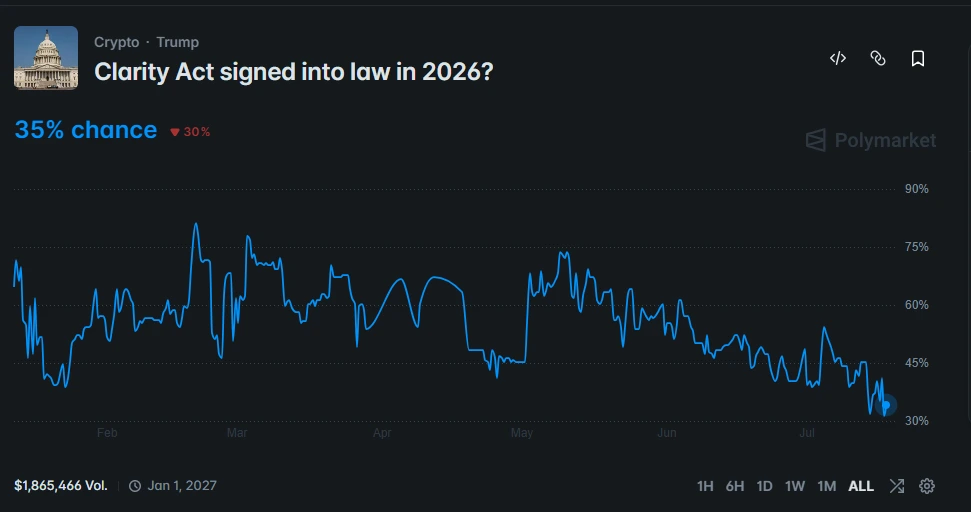
The odds of the Digital Asset Market Clarity Act passing have now dropped to 35% on Polymarket, as the US Department of Justice (DoJ) expressed concern about the proliferation of crypto crime.
Clarity Act weakens anti-money laundering (AML) framework: DoJ
In an email addressed to the US Department of the Treasury, the DoJ said that the current version of the bill would “impose a higher burden of proof for prosecutions” in money-laundering cases.
The agency specifically highlighted Section 604 of the Act, which grants broad exemptions and safe harbor legal protections to non-custodial developers, decentralized services, mixers and automated protocols. It noted that such language would handcuff federal prosecutors upholding anti-money laundering frameworks.

The latest caveat comes after a similar one issued on June 23 by a coalition of four law enforcement agencies and Catholic groups.
Crypto lobby responds
Nonetheless, a hearing today saw Representative William Timmons second the bill. His argument, like many supporters’, is that it maintains America’s forefront position in global economics.
Additionally, Circle’s Chief Strategy Officer, Dante Disparte, said the bill actually strengthens national security because it requires stablecoins to be backed 1:1 by safe assets like US Treasuries.
To address the DoJ’s warnings and ethical concerns surrounding President Trump, senators are actively refining the bill’s text. Amendments include provisions for the US Securities and Exchange Commission (SEC) and the Treasury Department to jointly formulate specific AML rules for decentralized platforms.
Furthermore, the text expands the Treasury’s authority to sanction platforms deemed high-risk for illicit financing. Finally, any entities that maintain control over a crypto platform’s code would be required to comply with the Bank Secrecy Act (BSA).
The lawmakers are working under tight timelines, with the bill’s next hearing scheduled for next week. If unsuccessful, August 7 will be the next hard deadline for the bill, right before Congress takes a summer recess.
Was this writing helpful?
Story Ends Here
Trust with CoinPedia:
Investment Disclaimer:
All opinions and insights shared represent the author’s own views on current market conditions. Please do your own research before making investment decisions. Neither the writer nor the publication assumes responsibility for your financial choices.
Sponsored and Advertisements:
Sponsored content and affiliate links may appear on our site. Advertisements are marked clearly, and our editorial content remains entirely independent from our ad partners.
Read the Next News